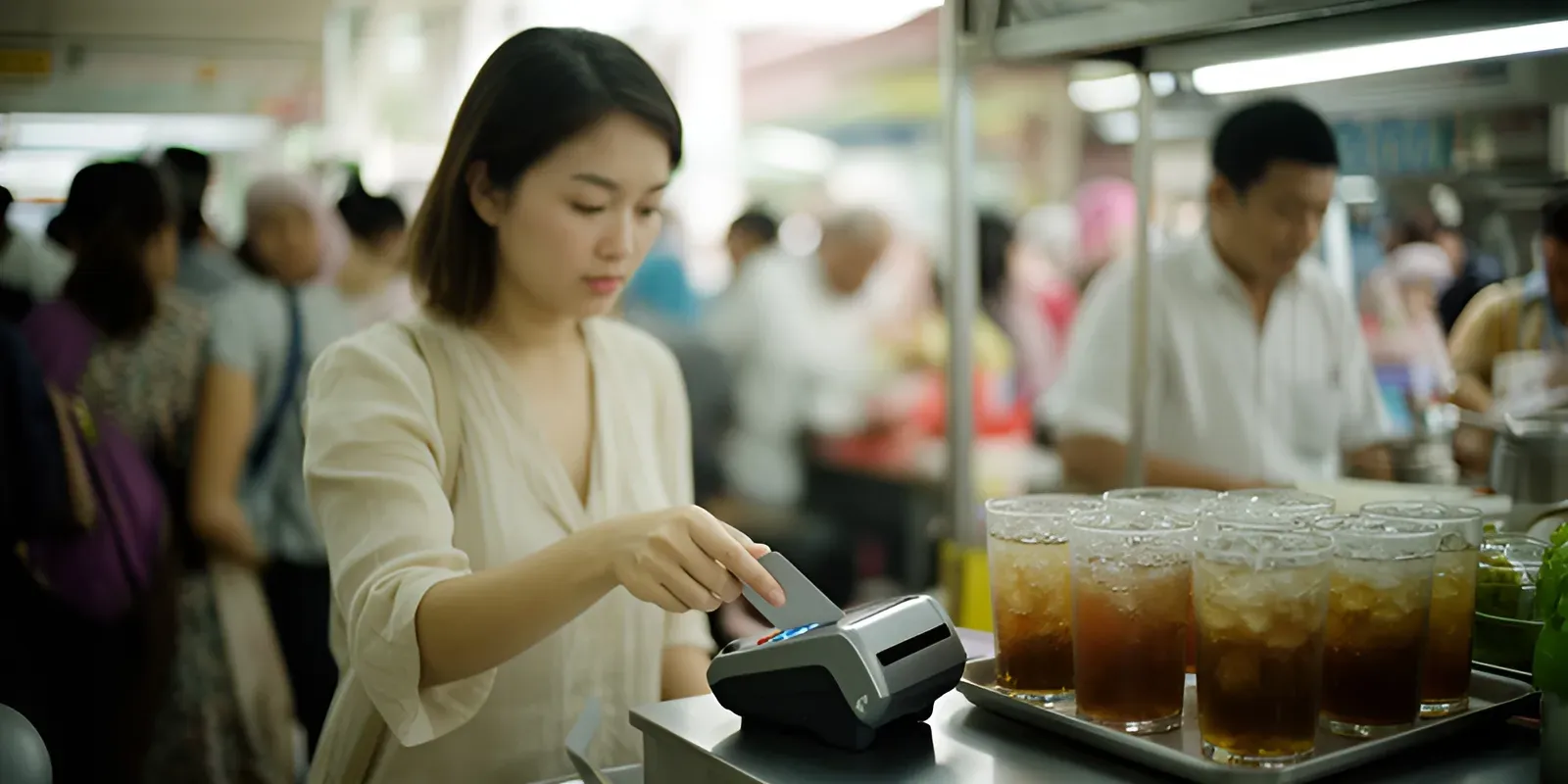
A debit card is a payment card linked to your bank account: every purchase or withdrawal takes money straight from your own balance. There is no credit limit, no monthly bill and no interest. In Singapore, most bank debit cards work three ways: at ATMs, for NETS payments with a PIN, and as a Visa or Mastercard for tapping, online shopping and overseas spending.
That makes a debit card the simplest way to pay by card without borrowing. The main costs are fees on overseas use, and the main risk is that fraud drains your own money until it is refunded.
What Is a Debit Card, and How Does It Work?
A Singapore bank debit card is usually three cards in one:
- ATM card. Withdraw cash, check balances and transfer money at your bank’s ATMs and shared networks.
- NETS card. Pay at local merchants by inserting the card and entering your PIN. The money comes out of your account.
- Visa or Mastercard. Tap to pay, add the card to Apple Pay or Google Pay, shop online and pay overseas, wherever the card network is accepted.
When you pay by Visa or Mastercard, the merchant first places a hold on your balance. The money is taken when the merchant settles, which can be a few days later. HSBC’s debit card page, for example, says a pending transaction is dropped if the merchant does not submit it within 21 days. Cashback programmes usually count transactions by this later posting date, not the day you paid.
Banks set daily limits that you can change in their app. DBS, for example, lists default daily limits of $5,000 for NETS, $3,000 for ATM withdrawals and $2,000 for card spending on its Visa Debit Card, as at November 2026.
Debit Card vs ATM Card, Prepaid Card and Credit Card
| Card type | Whose money | Can you owe interest? | Typical minimum age | Main use |
|---|---|---|---|---|
| ATM card | Your bank account | No | Varies by bank | Cash and NETS only |
| Debit card | Your bank account | No | 16 at DBS/POSB, OCBC and UOB | Cash, NETS, Visa/Mastercard spending |
| Prepaid or multi-currency card | Money you load into the provider’s account | No | Varies by provider | Travel and online spending |
| Credit card | The bank’s, repaid monthly | Yes, on any unpaid balance | 21 (POSB Everyday Card, for example) plus a minimum income | Spending, with rewards and an interest-free period |
Two of these differences matter most.
Prepaid cards are not bank deposits. Money loaded into most travel and e-wallet cards sits with a payment company, not in a bank account. Our prepaid card comparison explains how those funds are protected instead.
Credit cards are borrowing. Pay in full and you pay no interest. Pay less and interest builds quickly; MoneySense’s worked example uses a rate of 25% a year. Our debit card vs credit card guide sets out when each makes sense.
What a Debit Card Costs
The main bank debit cards in Singapore have no annual fee as at November 2026. The charges appear when you use the card overseas or lose it:
- Foreign currency spending: DBS’s fee guide adds 3.25% to foreign currency transactions on Visa and Mastercard; OCBC’s Debit Card page lists the same 3.25%.
- Paying overseas in Singapore dollars (dynamic currency conversion): DBS lists 2.80% on debit cards, and OCBC lists 2.80% too.
- Overseas ATM withdrawals: POSB charges $7 per withdrawal at most overseas ATMs. OCBC charges 3% of the amount (minimum $5, maximum $20), with no charge at OCBC’s own overseas ATMs.
- Card replacement: OCBC lists $21.80 including GST for its standard Debit Card.
Some banks waive the FX fee if you pay from a foreign currency wallet linked to the card, such as DBS’s multi-currency account or OCBC’s Global Savings Account. Our guide to FX fees and DCC explains why paying in the local currency usually costs less.
Worked Example: Debit vs Credit on a $1,000 Month
Take an illustrative 28-year-old who spends $1,000 a month by card. Illustration only.
- On a debit card with 1% cashback on all of it, they get about $10 a month back, and the money leaves their account as they spend. If the money is not there, the payment is declined.
- On a credit card paid in full, there is no interest and the rewards may be higher.
- On a credit card with $1,000 left unpaid for a month, at the 25% a year rate in MoneySense’s example, the interest is about $1,000 × 25% ÷ 12 = $20.83, plus any late fee. That wipes out two months of a 1% cashback.
The short version: A debit card is a card that spends only the money you have. It cannot run up interest, but it pays smaller rewards than a credit card and charges about 3.25% on foreign currency spending unless the card is built for travel.
Is a Debit Card Safe?
Card payments taken from a debit card come out of your own balance straight away, so unauthorised use hits your money first. Banks’ terms set out how losses are shared. DBS’s debit card terms, for example, cap your liability for unauthorised transactions not caused by your negligence at $100, and say refunds can take up to 14 days to process. MAS’s E-Payments User Protection Guidelines set out the duties of banks and customers when an unauthorised transaction happens.
Practical steps help more than any rule:
- Turn on transaction alerts in your bank app.
- Switch off overseas, online or contactless use when you do not need it. DBS, for example, lets you do this in digibank without affecting NETS and ATM use.
- Keep a lower daily card spending limit than the default.
The money in the account behind your card is a bank deposit. MoneySense explains that Singapore-dollar deposits with a Deposit Insurance Scheme member are insured up to $100,000 per depositor per bank. Foreign currency deposits are not covered.
Who a Debit Card Suits, and Who It Does Not
A debit card suits teenagers and young adults getting their first card (from 16 at the main banks), anyone who wants to avoid borrowing, and people who prefer to see spending leave their account straight away.
It does not suit someone who pays a credit card in full every month and wants the highest rewards, or anyone who spends heavily overseas on a standard card and pays 3.25% each time. For those, compare options in our best debit cards comparison and our multi-currency card guide.
What To Do Next
- Check which card came with your savings account: an ATM card or a full debit card.
- In your bank app, review the daily limits and switch off any functions you do not use.
- Before a trip, check the FX and overseas ATM fees on your card’s page.
- Choosing an account first? Our hub on the best savings accounts in Singapore compares them. For a child’s first card, see our kids’ debit card guide.