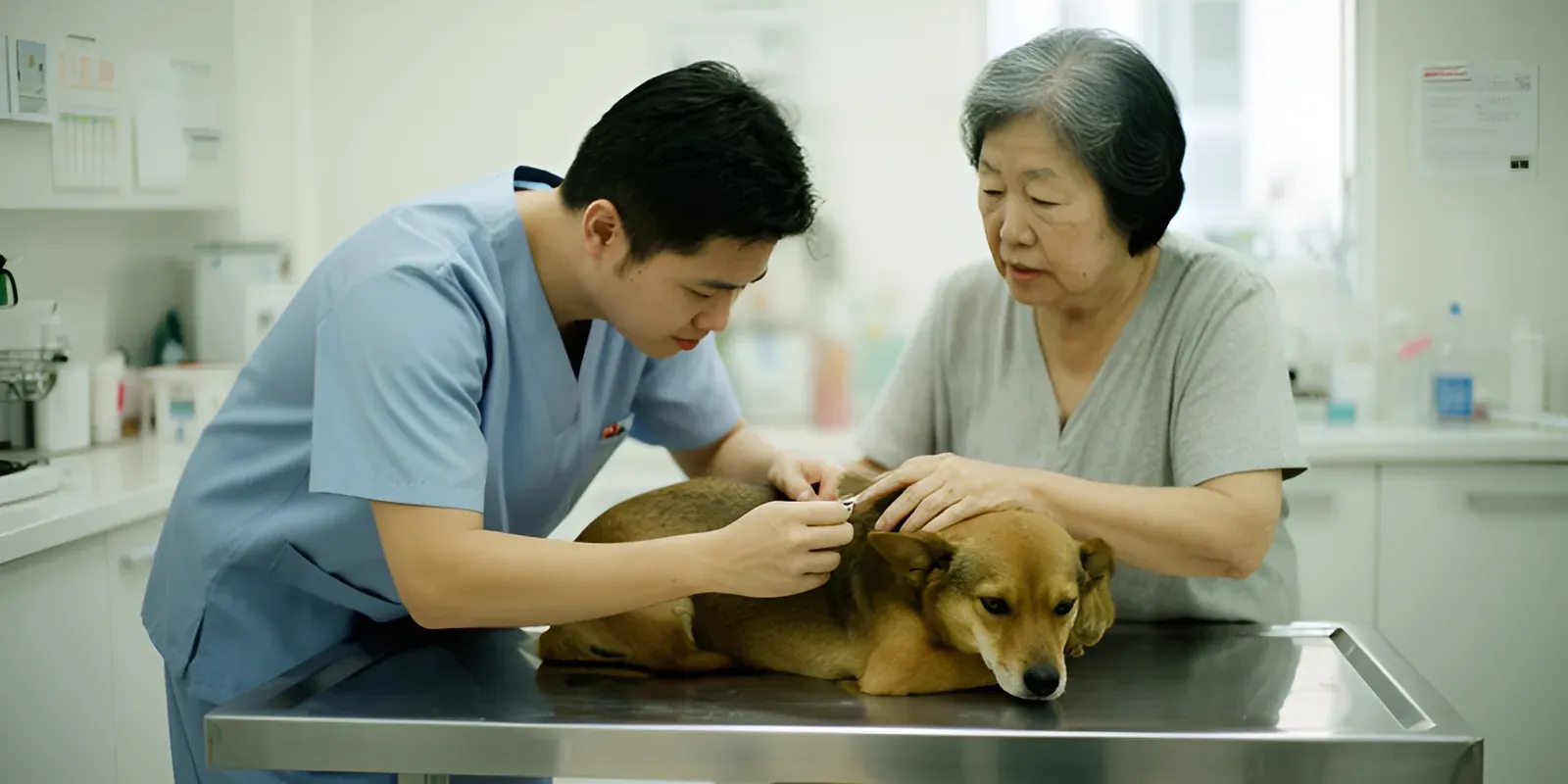
The best pet insurance in Singapore is the plan whose limits match the kind of vet bill you could not pay from savings, after its co-insurance, deductible and waiting periods are taken off. Pet insurance does not pay the whole bill. On the plans we checked, you pay 20% to 40% of each claim plus a fixed deductible, and routine care is not covered at all.
Few insurers sell stand-alone pet insurance here. We compare the two whose own pages set out full terms as at November 2026, and explain how to read any other plan you are offered.
What the Law Requires of Pet Owners
The Animal & Veterinary Service (AVS) requires all dogs and cats to be licensed. Insurance is a separate matter and is optional for most pets.
The exception is specified dogs. For breeds on AVS’s list, which includes Rottweilers, German Shepherds, Bull Terriers, Mastiffs and Akitas, the owner must hold:
- An insurance policy of at least S$100,000, approved by AVS, covering injury to persons or animals and damage to property caused by the dog.
- A banker’s guarantee or insurer’s bond of $5,000 for Part 1 breeds or $2,000 for Part 2 breeds.
AVS says both must be submitted within four weeks of the licence application and again at each renewal. If you own a specified dog, ask the insurer whether its policy is accepted by AVS before you buy.
The short version: Compare the share of the bill you pay, not the headline limit. Check the co-insurance for your pet’s age, the deductible, the waiting period, and whether non-surgical illness is covered at all.
How We Compared, and Why Only Two Insurers
We looked for insurers that publish the full schedule on their own website: plan limits, co-insurance, deductible, waiting periods and eligibility. As at November 2026 we could confirm these for Income’s Happy Tails and for Tiq by Etiqa’s pet insurance.
Other pet plans are sold in Singapore. We left out any whose terms we could not read on the insurer’s own page. This is a comparison of two, not a ranking of the market, and neither insurer pays to be included.
Best Pet Insurance in Singapore: Two Plans Compared
| Income (Happy Tails) | Tiq by Etiqa (Pet Insurance) | |
|---|---|---|
| Animals | Dogs and cats | Dogs and cats |
| Age when you first buy | 16 weeks to below 9 years | 8 weeks to below 9 years |
| Plan tiers | Furry, Furbulous, Furrific | Pawsome, Pawmazing, Pawtastic, Pawfect |
| Overall limit | $8,500, $15,000 or $27,000 a year | $10,000 to $45,000 over the pet’s lifetime |
| Surgery | Clinical and surgical: $6,000, $12,000 or $22,000 a year | Surgical illness: $2,000 to $15,000 |
| Illness without surgery | Not covered | $500 to $3,500 |
| Co-insurance (your share) | 20% if enrolled before 4; 30% before 7; 40% before 9 | 20% if enrolled before 4; 30% before 9 |
| Deductible | $250 per incident | $200 for illness |
| Waiting period for illness | 90 days | 3 months |
| Third-party liability | $250,000, $500,000 or $1,000,000 | None on Pawsome; $100,000 to $500,000 on higher tiers |
Source: each insurer’s own product page, as at November 2026. Terms and conditions apply; the policy wording governs.
The two plans are built differently
Income’s limit resets each year, and its page says non-surgical treatment for illness is not covered. Its cover centres on surgery, chemotherapy and hospital stays.
Tiq’s page describes a lifetime limit per pet across its medical sections, with a smaller amount for illness treated without surgery. A lifetime limit does not refill once used.
Neither design is better in general. A pet with a chronic illness treated by medication, and a pet that needs one large operation, would be served differently.
Both ask for proof of health
Both insurers require the pet to be microchipped and vaccinated. Income’s page requires a clinical examination before or within 30 days of the start date. Tiq’s page ties its hereditary and congenital cover to a clinical examination form submitted within 30 days.
The Maths: What You Pay on a $4,000 Operation
Take an illustrative dog enrolled at age 2 on Income’s plan, needing covered surgery that costs $4,000. Income’s page says the 20% co-insurance applies first, then the $250 deductible.
- Bill: $4,000
- Your co-insurance at 20%: $800
- Deductible: $250
- You pay $1,050. The plan pays $2,950, if within the plan’s limits.
Now the same dog first enrolled at age 8, where co-insurance is 40%.
- Your co-insurance at 40%: $1,600
- Deductible: $250
- You pay $1,850. The plan pays $2,150.
The age at which you first buy changes the result by $800 on a single bill. Income’s page says the 20% rate stays for life if the pet is enrolled before 4 and cover is kept without a break.
This is an illustration only. Ask the insurer to confirm how co-insurance and the deductible combine on the plan you are quoted.
What Pet Insurance Does Not Cover
The exclusions matter more than the limits. Income’s page lists:
- Pre-existing conditions, including anything a vet noticed before enrolment.
- Hereditary and congenital conditions that show signs before enrolment or during the 12-month waiting period.
- The other side of a pre-existing condition: if one knee was already affected, the same problem in the other knee is excluded.
- Preventive and routine care: vaccinations, parasite control, dental cleaning, grooming, and spay or neuter procedures.
- Working pets and racing dogs, which are not eligible.
Cover for an older pet is not automatic either. Income’s page says cover beyond age 9 continues at the insurer’s discretion, with new terms and possibly a higher premium.
Who Pet Insurance Does Not Suit
- Owners who mainly want help with routine vet visits. Annual check-ups and vaccinations are excluded.
- Owners of a pet with a known condition. That condition will not be covered.
- Owners of a pet aged 9 or older who have never held a policy. Neither plan here accepts new pets at that age.
- Owners who can comfortably self-insure. Setting money aside each month for vet bills is a reasonable alternative, and that money stays yours if it is not used.
A smaller option exists inside some home policies. FWD lists a pet add-on of up to $1,000 for a dog or cat that is stolen, injured or dies because of an insured event at home. Singlife’s Home Plus plan lists cover for the accidental death of a pet. These are not medical insurance.
What To Do Next
- Check that your dog or cat is licensed and microchipped. Insurers ask for both.
- Write down your pet’s age and any condition a vet has already noted, then read each plan’s co-insurance band and exclusions against those two facts.
- Ask for the policy wording, not only the brochure, and find the section on renewal at older ages.
- Decide between a premium and a savings pot. Our monthly budget planner can hold either as a monthly line.
- Reviewing household cover? See our home insurance comparison for liability and contents, and our travel insurance comparison for your own cover when you travel.